




Are F1 Cars Rear Wheel Drive?
Yes. Formula 1 cars are rear-wheel drive. The 2026 FIA technical regulations state that the transmission may only drive the two rear wheels. The rules also prohibit systems that automatically prevent the driven wheels from spinning under power.
This drivetrain layout allows the power unit and gearbox to deliver acceleration torque to the rear axle, while the front wheels are primarily responsible for steering.
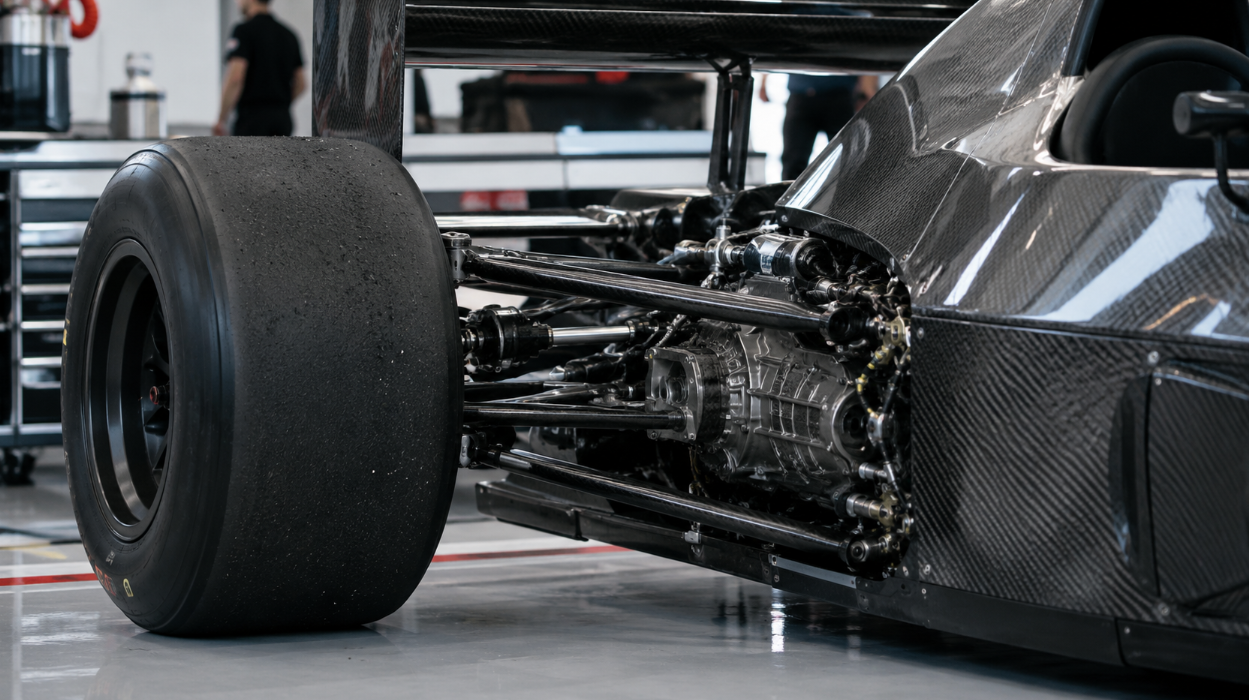
Table of Contents
How Does Power Reach the Rear Wheels?
A Formula 1 car combines a power unit, clutch, gearbox, differential, drive shafts, and rear wheels.
Power Unit and Gearbox
The power unit generates torque, which is transmitted through the clutch and gearbox.
The gearbox provides several ratios so the engine and electrical systems can operate effectively across different speeds and track conditions.
Rear Differential
The differential transfers torque to the two rear wheels while allowing them to rotate at different speeds through a corner.
Its operation affects traction, stability, tire use, and the way the car responds when the driver applies the accelerator.
Drive Shafts
Drive shafts connect the differential output to the rear wheel assemblies.
These parts must transmit high loads while remaining light and compact enough to fit within the rear suspension and aerodynamic package.
Why Does Formula 1 Use Rear-Wheel Drive?
Rear-wheel drive fits the layout and performance requirements of a modern single-seat racing car.
Acceleration Transfers Load Rearward
When a car accelerates, part of its weight transfers toward the rear axle. This can increase the vertical load available to the rear tires.
Sending torque to the rear wheels allows the car to make use of this load during acceleration, although actual traction still depends on tires, aerodynamics, track conditions, and driver input.
The Front Wheels Handle Steering
The front tires already perform steering and a large share of braking work.
Adding drive components to the front axle would change suspension geometry, steering, weight, cooling, and aerodynamic packaging.
The Powertrain Is Behind the Driver
The power unit and gearbox are positioned behind the driver. A rear-wheel-drive configuration creates a direct path from the transmission to the rear axle.
The gearbox also forms part of the structural area supporting the rear suspension.
Does an F1 Car Have Traction Control?
Modern Formula 1 rules do not allow a system that automatically prevents the driven wheels from spinning under power.
The Driver Controls Wheelspin
The driver must manage throttle position according to available grip.
Too much power can cause the rear tires to spin, particularly on wet surfaces, cold tires, curbs, painted lines, or slow corner exits.
Setup Still Influences Traction
Suspension setup, tire temperature, differential behavior, aerodynamics, and engine mapping all affect how easily the rear wheels can apply torque.
These systems help optimize performance, but they cannot function as prohibited automatic traction control.
Are Road Cars Similar to F1 Cars?
Some performance road cars also use rear-wheel drive, but the operating environment is very different.
Road Cars Use Driver Assistance
Road cars may include traction control, electronic stability control, anti-lock brakes, comfort-oriented suspension, and tires designed for different temperatures and weather.
Formula 1 cars are designed for professional circuit use, frequent inspection, specialized tires, and controlled race conditions.
Rear-Wheel Drive Is Not Automatically Better
Front-wheel drive, rear-wheel drive, and all-wheel drive each have advantages for different vehicle types.
The Formula 1 drivetrain is optimized for racing and should not be used alone to decide which layout is best for everyday driving.
What Is a TGIC-Cured Polyester Resin System?
The drivetrain topic concerns vehicle engineering, while a TGIC-Cured Polyester Resin System concerns industrial surface finishing.
TGIC-cured powder coatings combine carboxyl-functional polyester resin with TGIC curing agent. During heating, the materials react to form a crosslinked coating film.
Outdoor Durability
TGIC polyester systems are recognized for weather resistance, UV stability, crosslink density, and consistent film formation.
They are commonly considered for architectural profiles, outdoor furniture, machinery housings, railings, and other exterior metal products.
Automotive-Related Applications
Suitable formulations may be used on automotive accessories, workshop cabinets, equipment frames, wheels, brackets, metal housings, and transport-related components.
This does not mean that a specific Formula 1 team uses our materials. Motorsport components are developed under specialized weight, temperature, certification, and performance requirements.
Formulation Variables
Final coating performance depends on the polyester acid value, TGIC ratio, pigments, Additives, Fillers, extrusion conditions, metal pretreatment, film thickness, and oven profile.
Selecting a resin grade alone does not guarantee the complete coating result.
How Our Factory Controls Resin Quality
Our factory supplies multiple TGIC-cured polyester resin grades for outdoor and industrial powder coatings.
Batch Parameter Management
Important indicators include acid value, viscosity, color, glass-transition temperature, melt behavior, and curing response.
Each batch is monitored to support stable extrusion, curing, and film formation.
Technical Grade Selection
Buyers can provide their polyester-to-TGIC ratio, target gloss, curing temperature, mechanical tests, weathering requirements, and end-use application.
Our technical team can then recommend suitable grades for comparative laboratory testing.
Request a TGIC Polyester Resin System
Developing powder coatings for automotive accessories, wheels, transport equipment, workshop systems, or outdoor machinery? Send us your curing ratio, oven schedule, target gloss, weathering standard, color range, and purchasing volume. We will recommend a TGIC-Cured Polyester Resin System and prepare a quotation.